
%20rotate(-45.000000)%20translate(-10.110913,%20-10.610913)%20'%20cx='10.1109127'%20cy='10.6109127'%20r='9'%3e%3c/circle%3e%3crect%20id='Rectangle'%20stroke='%237F8DC6'%20fill='%237F8DC6'%20transform='translate(20.293250,%2020.793250)%20rotate(-45.000000)%20translate(-20.293250,%20-20.793250)%20'%20x='18.4932504'%20y='15.3932504'%20width='3.6'%20height='10.8'%20rx='1.8'%3e%3c/rect%3e%3c/g%3e%3c/svg%3e)
'%20id='close-icon-top'%20stroke='%237F8DC6'%20stroke-width='3'%3e%3c/line%3e%3cline%20x1='3'%20y1='13.5'%20x2='23'%20y2='13.5'%20transform='rotate(-45,%2013,%2013.5)'%20id='close-icon-bottom'%20stroke='%237F8DC6'%20stroke-width='3'%3e%3c/line%3e%3c/g%3e%3c/svg%3e)
'%20stroke='%237F8DC6'%20stroke-width='2'%3e%3cg%20id='Group'%20transform='translate(131.000000,%20779.000000)'%3e%3cg%20id='icons/sep'%20transform='translate(76.500000,%204.000000)'%3e%3cline%20x1='0.5'%20y1='0'%20x2='0.5'%20y2='16'%20id='sep'%3e%3c/line%3e%3c/g%3e%3c/g%3e%3c/g%3e%3c/g%3e%3c/svg%3e)
%20scale(-1,%201)%20rotate(90.000000)%20translate(-6.500000,%20-10.500000)%20'%20points='-2%2015%206.50030075%206%2015%2015'%3e%3c/polyline%3e%3cline%20x1='18'%20y1='10.5'%20x2='2'%20y2='10.5'%20id='Path-4-Copy'%20stroke='%23222155'%20stroke-width='3'%3e%3c/line%3e%3c/g%3e%3c/svg%3e)
%20rotate(90.000000)%20translate(-13.500000,%20-10.500000)%20'%20points='5%2015%2013.5003007%206%2022%2015'%3e%3c/polyline%3e%3cline%20x1='18'%20y1='10.5'%20x2='2'%20y2='10.5'%20id='Path-4'%20stroke='%23222155'%20stroke-width='3'%3e%3c/line%3e%3c/g%3e%3c/svg%3e)
Humans Have Layers
If ogres and donkeys have layers, why wouldn’t humans, too? Psychology has been exploring the concept that human personalities are not one homogeneous thing. There are a number of theories that posit different parts, ego states, or sub-personalities that contribute to our complete personality. In her book, Befriending Your Inner Child, Brya Hanan talks about four layers inside of us. At our very core is what she calls the Imago Dei, which is Latin for “image of God.” You are willed by God, you are simple, pure, holy, meant to be. It is good that you are, and you are part of the “very good” of creation. You are valuable and valued, safe, loved, worthy of love, and you reflect the face of God, and reveal a unique aspect of who God is. At our very core we are good, and sin has not damaged the core of who we are.
Wounded Child
Now, most people reading this bulletin article are not nodding their head saying, “Yes, that’s me!” They are more likely thinking, "Those words apply to a newborn baby or my grandchildren, but that can’t be me." Sometime between now and your conception, most of us experienced various forms of trauma. The deepest traumas are held in a layer called the “Wounded Child.” Psychologists identify two different kinds of trauma: Type A and Type B. Type B is “Bad things that happened.” It results from specific traumatic events, such as physical, sexual, or verbal abuse; bullying; assault; a car accident; etc, —both when they are experienced and witnessed. Type B events cause trauma when they overload a person’s capacity to address the injury, and that person has no one to turn to as a safety net. It's not so much the bad event itself, but the being alone in that bad event that leads to trauma.
Type A trauma is “the Absence of good things.” It comes about as the result of neglect, that is, basic needs not being fulfilled. Type A traumas include things such as abandonment, malnutrition, lack of affection or attention, absence of age-appropriate limits, an unhealthy emotional environment in the home, or even the lack of teaching basic life skills. Type A traumas are less visible to the human eye than Type B trauma, but they always cause damage, particularly when they occur during childhood years. Early Type A trauma impacts the brain’s ability to develop a stable personality and create meaningful relationships. We tend to cope by brushing trauma into the dark corners of conscious awareness. There it can take the form of a “Core Wound”: Shame, Hopelessness, Powerlessness, Fear, Rejection, Abandonment, and Confusion.
The "Clever" Teen
As we grow, we then develop a third layer. I like to call this layer the “Clever” Teen. Our “Clever” Teen part says, “I don’t like it when I feel ___ (Hopeless, Abandoned, Shame, etc.). I can fix this. I will figure out how to never, ever have to feel like that again.” This part accepts the idea that no one is there for us; we have to fix it ourselves, and it looks for strategies. That can include “Being Perfect”, so people won’t reject me. Or, “If we don’t try, then we never have to experience failing.” There are all sorts of clever tricks we use to manufacture a sense of safety and control for ourselves. But the wounds are not healed. The “Clever” Teen is a way of life based in fear. We are always afraid that these uncomfortable feelings will bubble to the surface.
The “Clever” Teen part of us is working around the trauma. But even if you forgot it happened, the trauma isn’t gone. It has a tendency to repeat itself. Jane hates feeling Abandoned. That leads her to pursue friendships so she’ll never have to experience abandonment again. But the fear keeps her from really connecting with people, and the fear-based friendships don’t last. Then she feels even more abandoned. The same thing can happen with every core wound: Fear itself, Shame, Powerlessness, Hopelessness, Rejection, Confusion. The harder we try to “fix” the problem ourselves, the more likely it is come back and bite us.
The Search for Safety
The “Clever” Teen is motivated by fear. Healing is the movement away from a fear-based lifestyle and into a lifestyle rooted in love. It sounds easy but its actually really hard. And that’s because we have to find two things. We need to find safety in something bigger than ourselves, and we need to find a love that will not let us down. The safety and love that the “Clever” Teen is trying to manufacture aren’t dependable enough. The cause more trauma every time they fail. Where can we find love? Where can we find safety? It’s not so far away!
Remember our Imago Dei? That part of us is deeply rooted in God’s love. The secret of healing is actually to discover that, at our deepest place, we are already safe and we are already loved. We are cradled in the arms of Our Father and sheltered in the heart of Mother Mary. This isn’t just wishful thinking. Right now at your deepest core, you are loved and you are safe.
Integration
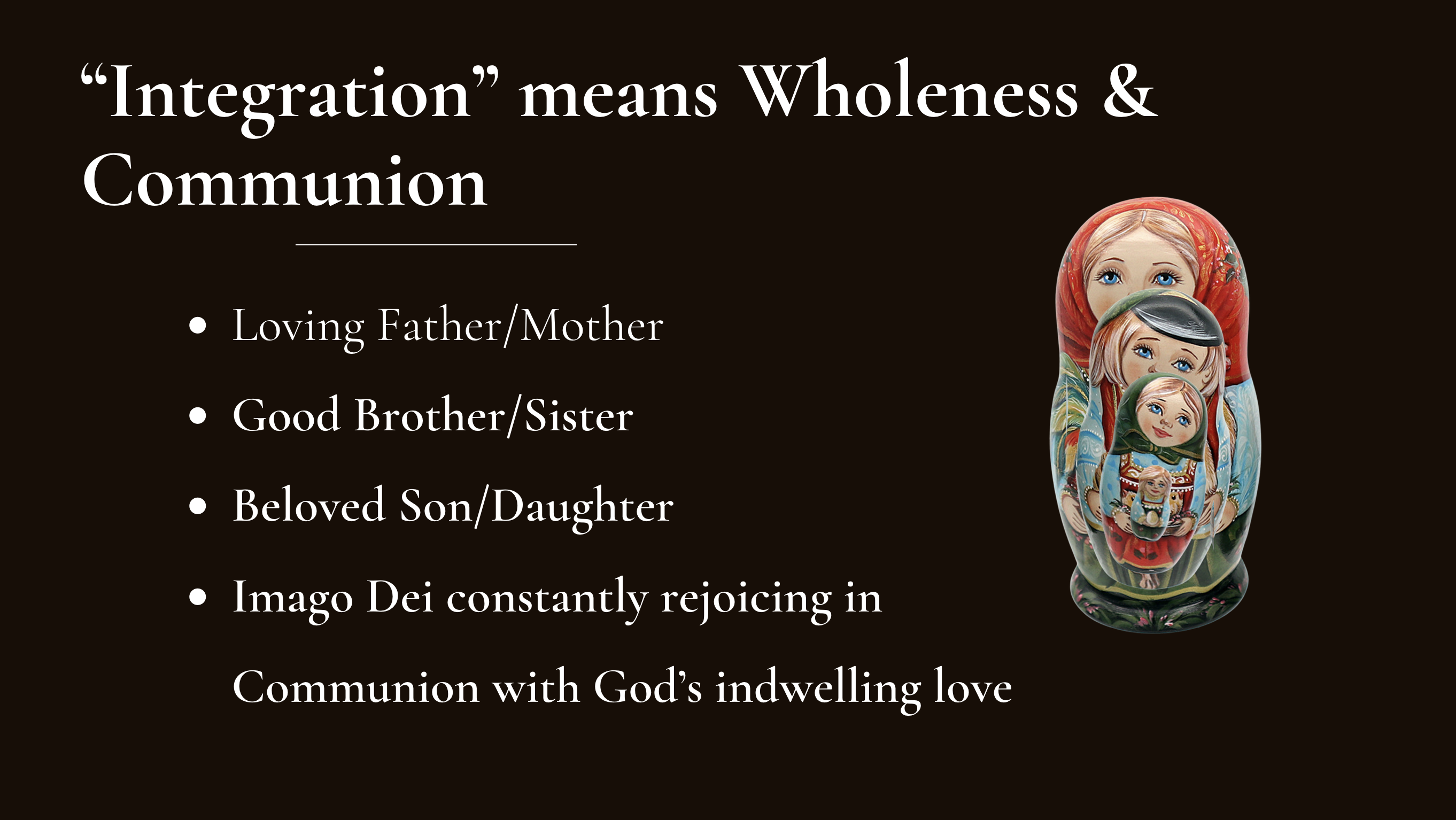
There is another part called the Adult Self. When this part becomes active we feel Calm, Curiosity, Compassion, Clarity, Courage, Confidence, Creativity, and Connectedness. The Adult Self needs to ask the “Clever” Teen can step back, so you can connect with your Wounded Child. The Adult Self needs to listen to a wounded child, much like a grownup loving a little kid. Then they both need to turn to Jesus, Mary, the Holy Spirit, or God the Father. There, the Wounded Child discovers its true identity as a Beloved Son/Daughter. The “Clever” Teen becomes a Good Brother/Sister. And the Adult Self can become a Loving Father/Mother. Slowly, your whole self becomes integrated into a communion, a team of parts, rooted in the safety and love that only God can provide.
How Do You Know You Need Healing?
You look like you have it all together, but you really have to work at it, and that “not good enough feeling” comes up when things are quiet. This experience tells you that your “Clever” Teen is working really hard and underneath you have a Wounded Child carrying shame or failure or other hurts. Something happens and it bothers you more than it should. This tells you that you have a sensitive place because the current distress, which is not a big deal, is poking something much deeper. If connecting with others doesn’t feel safe, or, conversely, you can’t stand to be alone. You might bounce back and forth between pulling people close to you and pushing them away. You feel like you have to be in control of everything. You lack peace and joy. These are all signs that you need healing.
Is It Worth It?
Healing is hard work. Taking the lid off painful places in your heart is painful and sensitive, and takes you to places you've spent years trying to avoid. A lot of people choose to keep letting their "Clever" Teen run their lives because it's familiar and "easier" than putting in the work to dig up the foundations and rebuild from the core. But healing is very freeing. Healing allows you to experience more peace and joy, and a greater freedom to love others and to allow yourself to be loved. Any step, no matter how small, will open you up to greater life and love. Deeper connections with others, feeling more rooted and grounded in who you are, and able to live more generously are all fruits of healing. As you heal and are able to love others more authentically, you also create safety and love for them, which can help them take steps towards wholeness and new life. Being able to walk with others on their healing journey is a beautiful fruit of putting in the work yourself. My hope is that our Catholic parishes become places of deep healing. Are you willing to take a step towards that dream?
Where to Go for Help
John Paul II Healing Center
They have come really good books in their STORE. I would recommend Be Healed, Be Restored, and Be Transformed. Be Devoted is a resource for marriage enrichment. A book is a safe, easy, and inexpensive place to start.
If you have more time (and money), check out the Events page on the John Paul II Healing Center website. They have events all over the country. You could fly somewhere and participate if you have the time and money. Alternatively, all their events allow live-stream participants. The final option would be their Online Courses. Right now they have two: Healing the Whole Person and Real Suffering. They are on the expensive side—personal access to Healing the Whole Person is $199. But It would be worth it, especially if you could do it as a group with a few Christian friends.
Other Books
Befriending Your Inner Child by Brya Hanan. See https://www.bryahananlmft.com
Brya’s website offers counseling and coaching services
Leaving Loneliness Behind - 5 Keys to Experiencing God’s Love and Building Healthy Connections with Others by Regina Boyd
Podcasts on Healing
Adam Young Counseling episode 159 - Revisiting the Big Six: What You Needed from Your Parents can be a very eye-opening if you came from a "normal" family and you thought your parents did a good job, but you still face issues. He says, "When you were a child, you were deeply dependent on your primary caretakers. This means that the development of your brain was contingent upon the level of care and kindness in your family environment. Today I identify the six things you needed from your parents, and give examples of each. The “Big Six” things you needed from your parents include (1) attunement, (2) responsiveness, (3) engagement, (4) ability to regulate your affect, (5) ability to handle your big emotions and (6) willingness to repair harm."
Restore the Glory with Dr. Bob Schuchts and Dr. Jake Khym, both former counselors who have gotten actively involved in healing.
Abiding Together featuring Sr. Miriam James, Heather Khym, and Michelle Benzinger. I find these to be encouraging, informative, and uplifting.
SoulsandHearts.Com is at the forefront of the psychological side of healing from a Catholic perspective. They are a little more focused on the counselor side of the equation, but they have a couple podcasts and a load of resources.

'%20stroke='%23DAB02C'%20stroke-linejoin='round'%20stroke-width='2'%3e%3cpolyline%20id='Path'%20transform='translate(12.000000,%2011.674232)%20rotate(-45.000000)%20translate(-12.000000,%20-11.674232)%20'%20points='11.3127269%202.24695917%2012%201.6742316%2015.3242117%204.44440805%2018%206.6742316%2018%2021.6742316%206%2021.6742316%206%2018.9756525'%3e%3c/polyline%3e%3c/g%3e%3cg%20id='fg-tag'%20transform='translate(9.000000,%2010.674232)%20rotate(-45.000000)%20translate(-9.000000,%20-10.674232)%20translate(3.000000,%200.674232)'%20stroke='%23DAB02C'%3e%3cpath%20d='M11,20%20L1,20%20C0.44771525,20%206.76353751e-17,19.5522847%200,19%20L0,5.46837495%20C-3.63450484e-17,5.1715951%200.13182301,4.89014749%200.3598156,4.70015367%20L5.3598156,0.533487%20C5.73066155,0.224448706%206.26933845,0.224448706%206.6401844,0.533487%20L11.6401844,4.70015367%20C11.868177,4.89014749%2012,5.1715951%2012,5.46837495%20L12,19%20C12,19.5522847%2011.5522847,20%2011,20%20Z'%20id='Path'%20stroke-width='2'%3e%3c/path%3e%3ccircle%20id='Oval'%20fill='%23DAB02C'%20cx='6'%20cy='6.3257684'%20r='2'%3e%3c/circle%3e%3c/g%3e%3c/g%3e%3c/svg%3e)
%20scale(-1,%201)%20rotate(90.000000)%20translate(-6.000000,%20-15.500000)%20'%20points='-8%2020%206.00049535%2011%2020%2020'%3e%3c/polyline%3e%3c/g%3e%3c/svg%3e)
%20rotate(90.000000)%20translate(-6.000000,%20-15.500000)%20'%20points='-8%2020%206.00049535%2011%2020%2020'%3e%3c/polyline%3e%3c/g%3e%3c/svg%3e)